The short version
- Most trees here are evergreen, so a bare canopy is a signal rather than the season
- Jacaranda, poinciana and frangipani do go bare in the cooler months and come back
- The scratch test takes ten seconds and tells you dead from alive
- Test several twigs on different sides, because trees often die from the top down
- Mushrooms or hard brackets at the base mean decay inside the wood
- A dead tree over a house gets more brittle every year it stands there
Dying, or just doing what it does in winter
Most of the trees in a Moreton Bay yard are evergreen, so a canopy that has gone thin or bare is worth a proper look rather than a shrug. In colder parts of the world nearly everything drops its leaves and bare is the normal winter state. Here it usually is not.
The exceptions are the trees people panic about most. Jacaranda, poinciana, frangipani and silky oak all go bare or close to it at some point in the cooler months, then leaf up again on their own.
So the first question is not whether the tree looks bad. It is whether this particular species is meant to look like that at this time of year.
A tree that is bare in July and still bare in November is not dormant. That is the point where the question stops being wait and see.
The scratch test, and how to do it properly
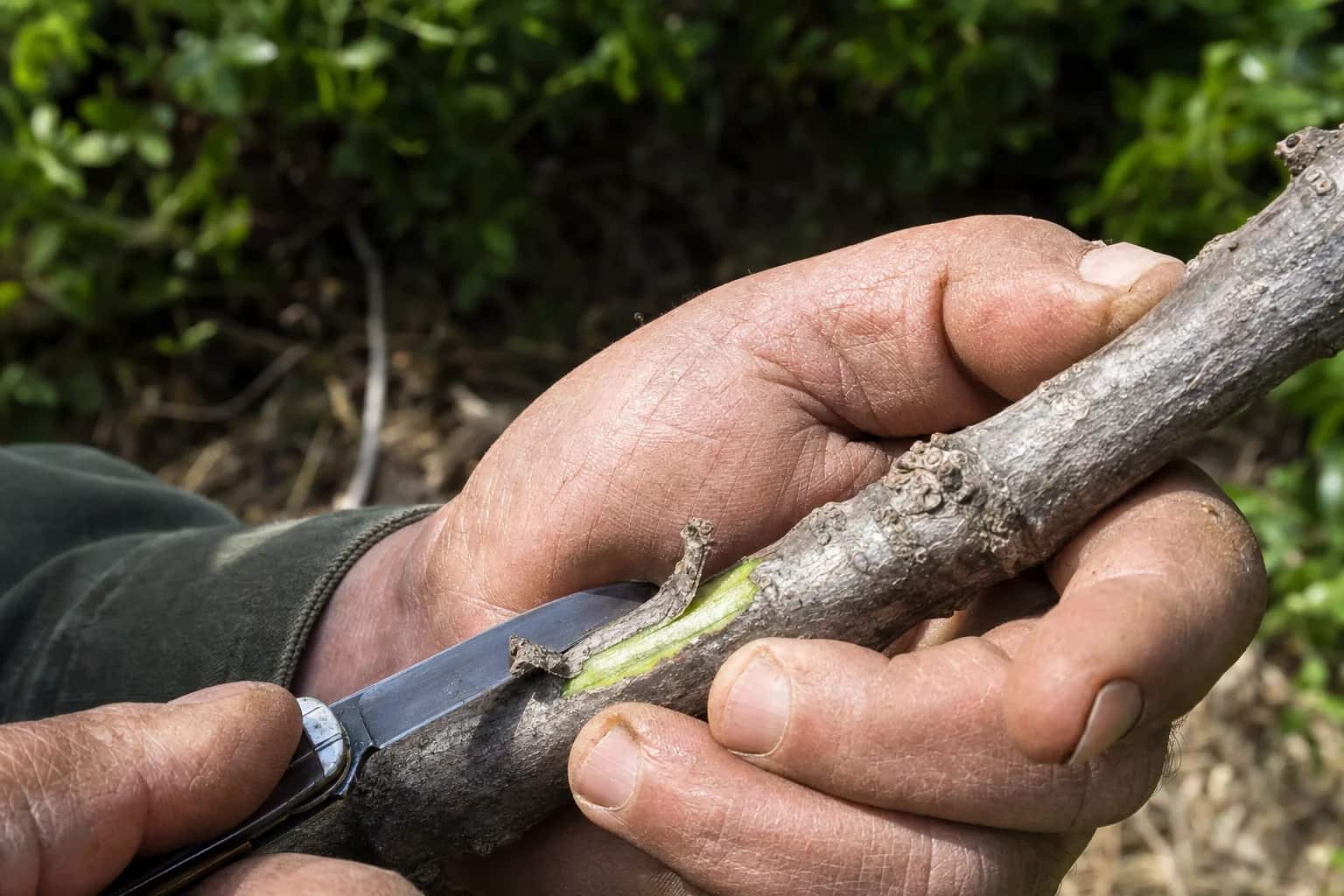
There is one test that settles dead against alive and it takes about ten seconds. Scratch a thin sliver of bark off a twig with a thumbnail or a pocket knife and look at the layer underneath.
Green or pale cream and slightly damp means the tree is still moving water through that limb. Brown, dry and brittle means that limb is gone.
- Test a twig you can reach rather than the trunk, because trunk bark is thick enough to tell you nothing
- Scratch just deep enough to get through the bark, roughly the thickness of a fingernail
- Do three or four twigs on different sides of the tree, not one
- Include a low branch and a high one if you can reach both, since trees often die from the top down
- Bend the same twigs while you are there, because live wood flexes and dead wood snaps clean
Four dead twigs on four sides is a dead tree. One dead twig and three green ones is a dead limb on a living tree, which is a completely different job.
What a dying tree looks like from the ground
Most of what you can read without climbing is in the canopy, and it is read by comparison. Against the same tree last season, or against its neighbours right now.
- Leaves that are smaller, paler or sparser than they were, or than the same species down the street
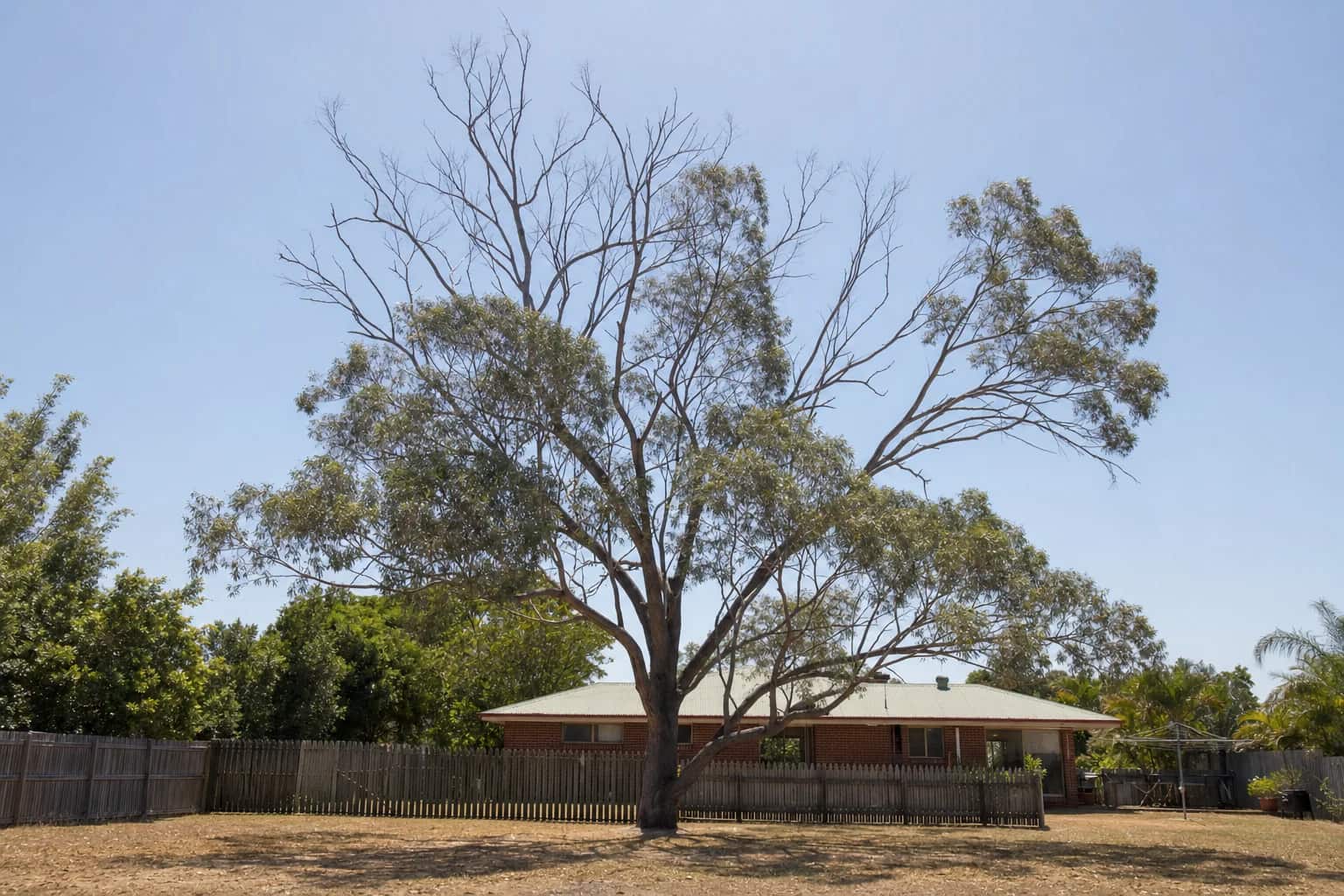
- Dead twigs and small branches held up in the outer canopy, especially when they are concentrated at the top
- A crown you can see noticeably more sky through than you used to
- Bark falling away and leaving dry, bare wood behind rather than fresh bark underneath
- Cracks or splits in the trunk or in a major union that were not there before
- Clusters of thin vertical shoots off the trunk or the big limbs, which are often a stress response rather than a sign of vigour
- Sawdust-like frass at the base or in the bark cracks, which points at borers working in the timber
One of those on its own is not a verdict. Three or four of them together, getting worse across a season, usually is.
Photographs help far more than memory here. One photo of the whole tree from the same spot each month turns a vague feeling into something you can actually compare.
The signs at the base are the ones worth worrying about
Canopy problems are the ones people notice. Base problems are the ones that put a tree through a roof.
- Mushrooms, or hard shelf-like brackets growing out of the trunk near ground level or off a surface root
- A cavity, a soft patch, or wood you can push a screwdriver into without much effort
- Soil lifted, cracked or domed on one side of the trunk, which can mean the root plate is moving
- A lean that has changed, particularly with fresh soil disturbance on the high side
- Roots cut through for a driveway, pool, shed or service trench in the last few years
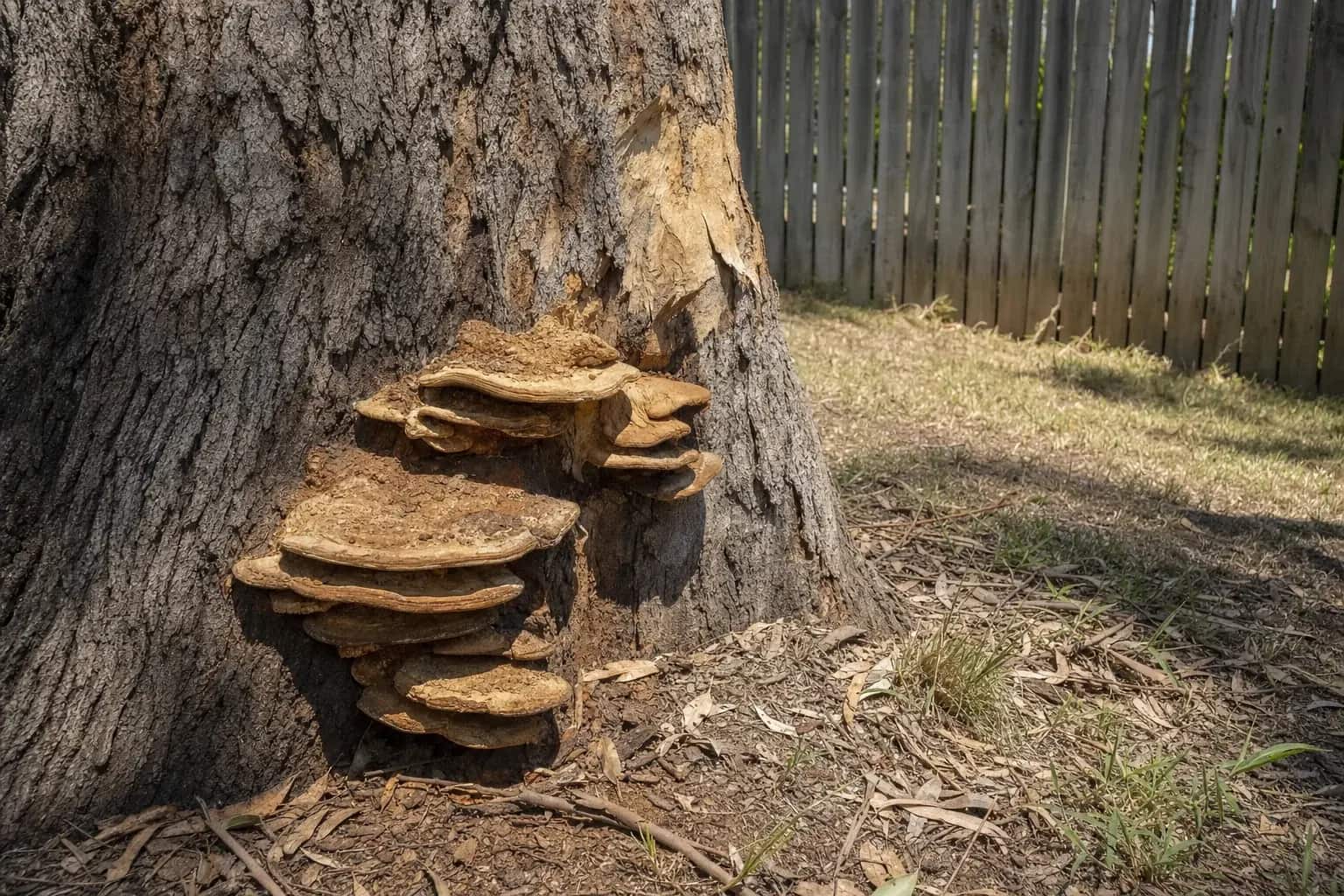
Brackets are the one to act on even when the canopy above still looks fine. By the time fruiting bodies appear on the outside, the decay feeding them has usually been inside the trunk for a good while.
Why trees die in this part of the world
Very few of them die of old age in a suburban yard. Most of what we get called to had something done to it, and the tree took a while to say so.
- Root damage from building work, where a pool, a shed slab, a new driveway or a trench cuts roots the tree needed
- Compaction, where machinery or a new hardstand packs the soil so tight that the roots cannot get air or water
- Changed drainage, and it goes both ways, since a tree sitting in water after a regrade is in as much trouble as one cut off from it
- Storm damage that never closed over, particularly a big tear where a limb ripped out instead of breaking cleanly
- Mulch or fill piled against the trunk, which keeps the collar wet and rots it
- Borers and pathogens, which more often finish off a tree that was already struggling than kill a healthy one
The pattern worth knowing is the delay. A tree damaged during a renovation often looks fine that year and thin the next, which is why the cause and the symptom almost never turn up together.
Trees that look sick and are not
A fair few of the calls we get are about a tree behaving exactly as its species is supposed to. Worth ruling that out before you go any further.
- Spotted gums, scribbly gums and ironbarks shed bark in strips and patches every year, and the fresh bark underneath is meant to look nothing like the old
- Paperbarks shed in papery sheets more or less constantly, which is the whole point of them
- Jacaranda, poinciana and frangipani go bare in the cooler months and come back in spring
- Mangoes drop a lot of leaf after fruiting and look rough for a while afterwards
- Lilly pillies get pimpling and bumps on the new growth from psyllids, which is ugly and rarely serious
- Sooty mould, the black film on leaves, is a symptom of scale or aphids above it rather than a disease of the tree
None of that means those species never get sick. It means the thing that made you look might be normal behaviour, and that is a cheap thing to check first.
Can a dying tree be brought back
Sometimes, and it depends entirely on what is wrong with it. A stressed tree has options. A structurally rotten one does not.
Where the cause is soil, water or damage that has already stopped, there is often something to work with. Time is usually the main ingredient.
- Worth doing: pull fill and turf back off the trunk base, mulch wide and thin out toward the drip line rather than piled against the collar, sort out the drainage, take the dead wood out and leave the live wood alone
- Not worth doing: topping it, which treats nothing and grows weak regrowth on a trunk that is already compromised
- Not worth doing either: reaching for fertiliser first, because feeding a tree that has a root problem does not fix the root problem
A tree that is more than roughly half dead through the canopy, or that has real decay in the trunk or the root plate, is generally past the point where anything sensible turns it around.
When a dead tree stops being a garden problem
A dead tree in the back corner of a paddock can stand for years and hurt nobody. A dead tree over a bedroom, a driveway or a boundary fence is a different thing entirely, and the difference is what sits underneath it.
Dead timber also gets more brittle and less predictable as it dries out. That is why a dead tree is often taken down from a machine rather than climbed, and why leaving it another two years tends to make the job harder rather than easier.
- Over a house, a shed, a play area, a driveway or a fence, deal with it rather than watching it
- Anything dead near a powerline is for your electricity distributor, not for you and not for a tree crew
- If a limb has already come down or the trunk has split, get it made safe before working out the rest
- If something is on the house or blocking access right now, the SES on 132 500 handles the emergency make safe
Storm season here runs from about October to March, and a dead tree that has stood through three quiet years is not evidence that it is stable. It is evidence that there has not been a strong enough wind yet.
What to do next
- Do the scratch test on a few twigs before anything else, because it costs nothing and it changes the question you are asking
- Photograph the whole tree from the street, the base, and anything in particular that worries you
- Ask Moreton Bay Regional Council whether the tree is protected at your address, since dead and dangerous trees are often treated differently but that is not a blanket exemption
- Get someone qualified to look at it if the base is involved, if the lean has changed, or if you simply are not sure
We will tell you straight if a tree is worth keeping. There is no sense taking out a tree that is going to be fine, and none in leaving one that is not.
Common questions
How can I tell if my tree is dead or just dormant?
Scratch the bark off a few twigs on different sides of the tree and look at the layer underneath. Green and slightly damp means alive, brown and dry means that limb is dead. Do several, because a tree can be dead at the top and still alive lower down.
At what point is a tree considered dead?
When there is no living tissue left under the bark anywhere in the canopy and nothing new has come away through a full growing season. A tree with green under the bark in some limbs and not others is declining rather than dead, and the two are handled differently.
Can a tree that looks dead be revived?
If the cause is stress rather than decay, sometimes. Correcting drainage, pulling fill away from the trunk and mulching properly out at the drip line all give a stressed tree a chance to recover. Once there is major decay in the trunk or the root plate there is nothing left to bring back.
Do I need to remove a dead tree straight away?
It depends on what is underneath it. A dead tree with nothing beneath it is rarely urgent, and one standing over a house, a driveway or a fence is. Dead timber gets more brittle the longer it stands, so waiting usually makes the job harder rather than easier.
Do I need an arborist to tell me a tree is dying?
Not for the obvious cases, because the scratch test and a careful look at the canopy will tell you plenty on your own. It is worth getting someone qualified when the trunk base or the roots are involved, since that is where the real risk sits and it is the hardest part to read from the ground.