The short version
- Storm season here is roughly October to March, so late winter is the time to look
- Dead limbs are the single most common failure, and the easiest to spot
- A union where two trunks meet with bark pinched between them is a genuine weak point
- End-heavy limbs over a roof fail more often than whole trees do
- Do not top a tree to make it safe, it makes it more dangerous within a few years
- Everyone rings on the same day after the first big storm, so book before it
When storm season actually starts here
South East Queensland's severe storm season runs from around October through to March, with the worst of it usually falling between November and February. That is the pattern, not a guarantee, and a bad one can arrive either side of it.
The useful thing about that timing is that it makes late winter the window for tree work. August and September are quiet, the ground is dry enough for machinery, and the crews are not yet three weeks deep in a backlog.
There is a second reason to go early. Anything cut now has the whole of spring to respond, so the tree goes into the wet season having already started closing its wounds rather than carrying fresh ones.
Every tree business in Moreton Bay gets the same run of calls the morning after the first big storm. Nobody can get to all of them at once, and the jobs that were already dangerous are the ones that jump the queue.
What actually fails in a storm
Whole trees blowing over makes the news, but it is the least common outcome on a suburban block. Far more damage comes from parts of otherwise healthy trees letting go.
- Dead limbs, which have no flex left and snap rather than bend
- Unions where two stems meet at a tight angle with bark pinched between them, so the join was never properly fused
- Long, end-heavy branches carrying all their weight at the far end, which act as a lever in wind
- Limbs already cracked from a previous storm and still sitting in the canopy
- Trees on saturated ground, where the roots let go before the timber does
That last one is why the second storm in a week is often worse than the first. The ground is already soaked, and a root plate that held on Tuesday will not necessarily hold on Friday.
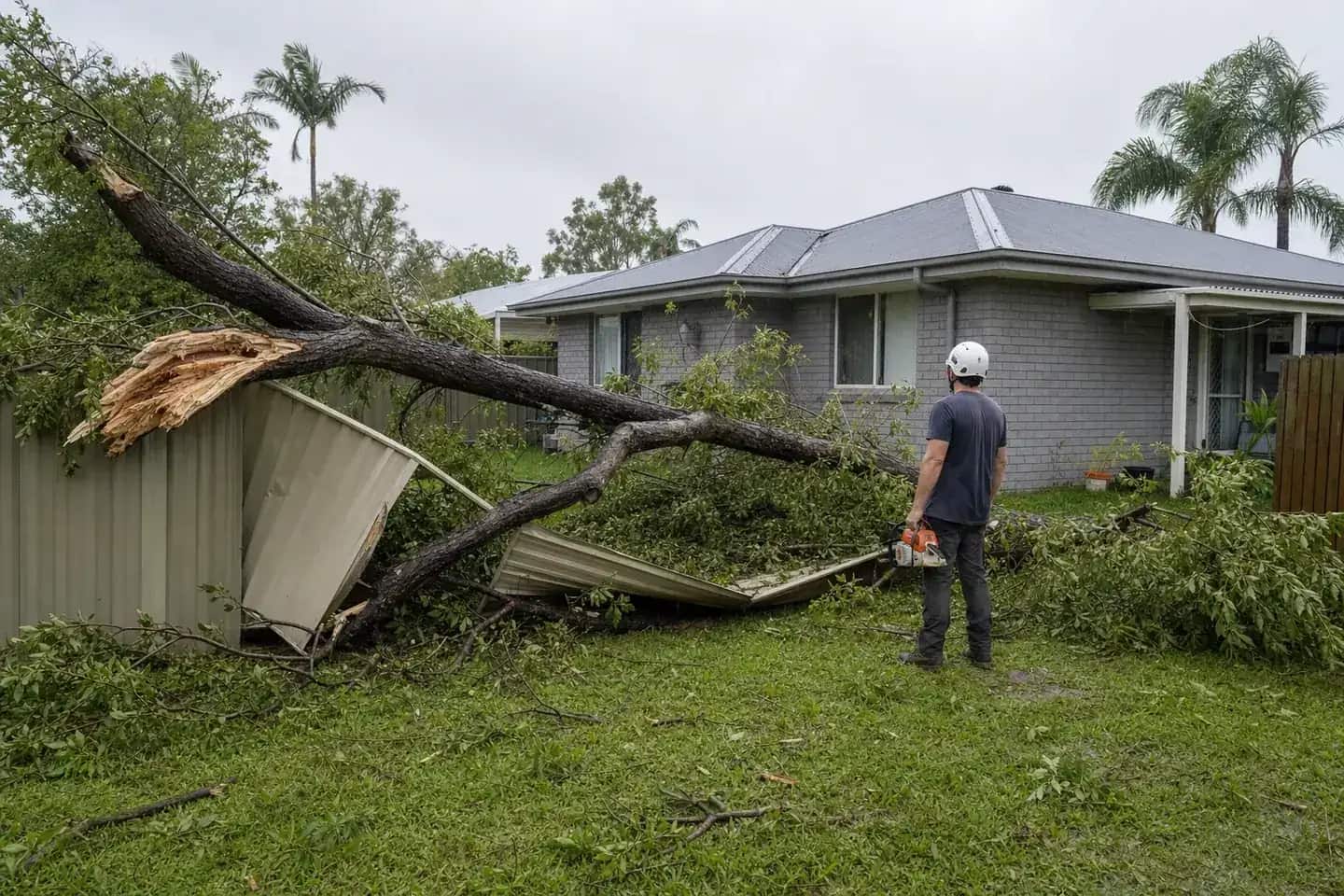
Notice what the photo above is not. Nothing has blown over, and the damage was done by a single limb letting go, which is the shape of most of the calls that come in after a storm.
The trees that give the most trouble around here
No species is guaranteed to fail and none is guaranteed to hold. Some are simply overrepresented in the calls that come in after a storm, and it is worth knowing if you have one over something you care about.
- Eucalypts, which shed limbs as a normal habit rather than as a fault, sometimes in still weather and usually from high in the canopy
- Poinciana, which grows wide and fast into heavy horizontal limbs on relatively soft timber
- Camphor laurel, which puts on enormous weight and often carries several codominant stems out of one point low down
- Cocos and other palms, where the risk is a heavy seed head and dead fronds dropping rather than the trunk failing
- Jacaranda and other brittle ornamentals, which take end weight badly once the limb gets long
- Anything that has been topped in the past, regardless of species, because the regrowth is attached rather than joined
Fast growth and soft timber tend to travel together. A tree that filled the yard in ten years did it by growing wood that is lighter and weaker than a tree that took forty.
Being on that list is not a reason to remove a tree. It is a reason to have a proper look at the ones sitting over the roof, the driveway or the kids' trampoline.
What you can check from the ground
You do not need to climb anything to do a useful inspection. Most of what matters is visible from the lawn with a pair of binoculars and ten minutes.
- Bare branches with no leaves while the rest of the tree is in leaf. That limb is dead
- Anything hanging, snagged or sitting at an odd angle in the canopy
- A tight V where two trunks meet, especially if there is a seam of bark running down into it
- Fungal brackets on the trunk or at the base, which suggest decay inside
- Cracks or a lifted lip of soil on one side of the base, which suggest the root plate has moved
- Limbs growing out over the roof, the driveway or the neighbour's fence
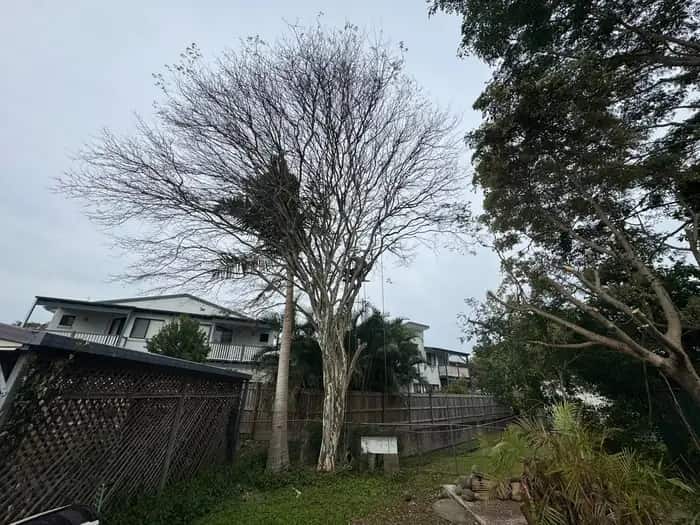
Do the walk twice, once from the yard and once from the street. The street view shows you the side of the canopy your own fence hides, which is usually the side leaning over the neighbour.
Photograph anything you are unsure about, with something in frame for scale. It saves a trip when you describe it to someone later, and it gives you a record of what the tree looked like before the season started.
None of those is proof a tree will fail. They are the things worth getting a second opinion on, and they are what an arborist looks at first anyway.
The thing not to do
The instinct before a storm season is to cut the height out of a tree so there is less of it to blow over. Topping does the opposite over any timescale longer than a season.
A topped tree responds by throwing out a mass of fast, upright regrowth from the cut ends. That regrowth is attached to the outside of old wood rather than joined into it, so within a few years the tree carries more weight, higher up, on unions that are weaker than the ones you removed.
The stubs left behind are the other half of the problem. A cut made in the middle of a limb has no growth point to seal from, so it stays open and decay moves down into the wood the new growth is hanging off.
Reduction cuts back to a suitable growth point do the same job properly. Same result in the short term, no forest of weak regrowth in the long one.
The bits people forget
Trees cause a fair amount of storm damage without anything breaking. Most of it is water going somewhere it should not, and most of it is preventable in an afternoon.
- Gutters and valleys packed with leaf litter, so the first heavy fall goes over the edge and back into the eaves
- Downpipes and stormwater pits blocked by the same litter, which is how a yard floods when the drain was fine last year
- Branches resting on the roof, which lift tiles and wear through sheeting every time the wind moves them
- Limbs growing into the service line running from the street to your house, which is the wire you are responsible for
- Shade sails and carports acting as a sail for a limb that would otherwise have fallen harmlessly onto grass
- Fruit and seed pods above a driveway, which are a nuisance rather than a danger but arrive in the thousands
The powerline point is worth separating out. Anything near the wires between the pole and your house is not a do-it-yourself job and there are minimum approach distances that apply to untrained people, so that one goes to your electricity distributor or to a contractor licensed for the work.
What is worth doing before November
For most suburban blocks it is a short list. Take out the deadwood, reduce anything end-heavy sitting over something expensive, and deal with limbs that were already damaged last season.
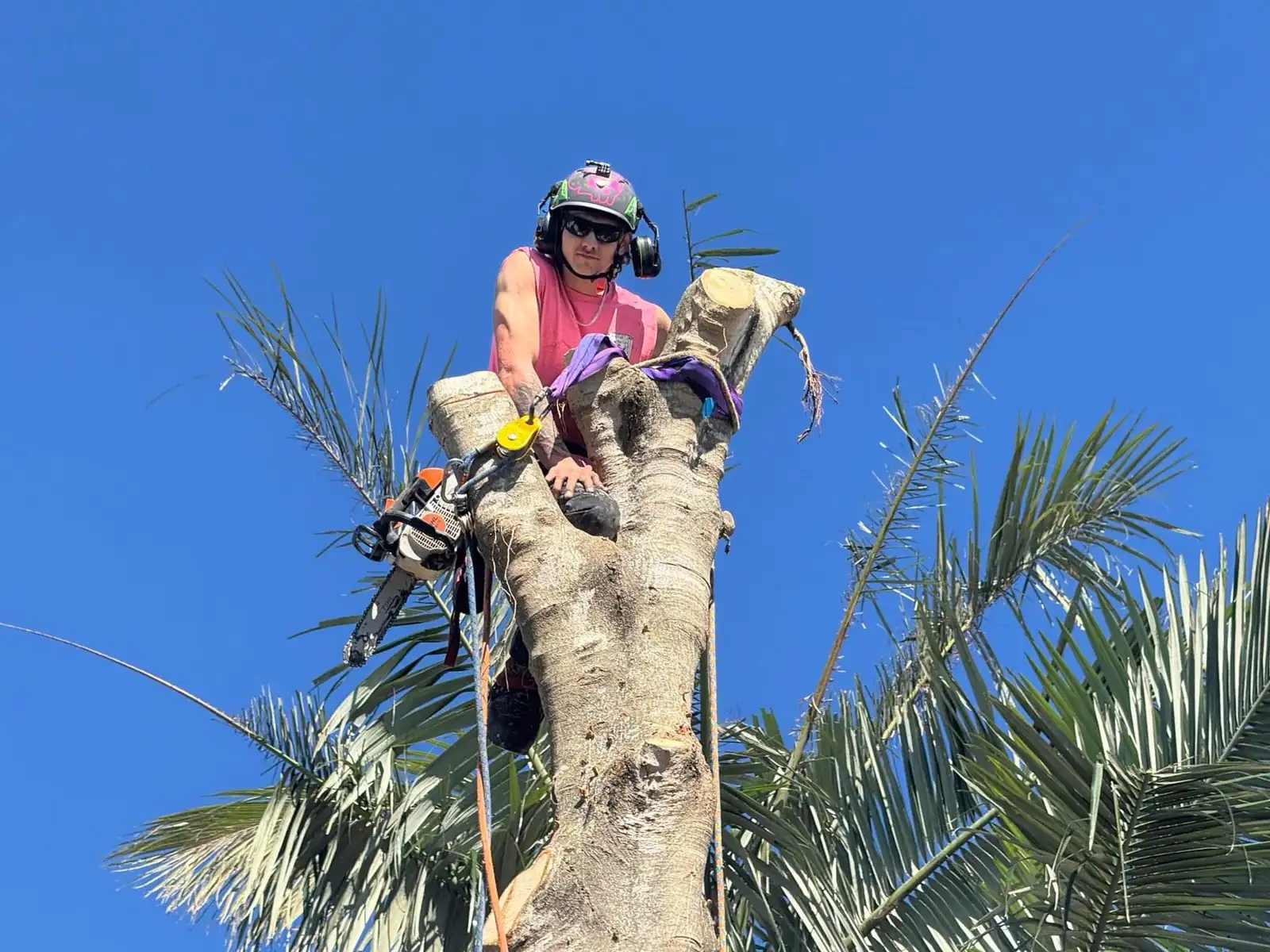
A crown thin is worth understanding before you ask for one. Taking out a measured amount of the inner growth lets wind through the canopy instead of pushing against the whole of it, and it does that without changing the shape of the tree from the street.
Clearance work is the other common job. Getting the canopy back off the roof, the gutter line and the fence removes the damage that happens every time it blows, not just the damage that happens in the big one.
If a tree is dead, leaning hard or has a union you do not like the look of, get someone to actually look at it rather than deciding from the ground. That is a free thing to have done and it settles the question either way.
After a storm, in order of danger
The first hour after a storm is when people get hurt doing the cleanup rather than in the storm itself. The order below is the one worth following.
- Anything touching or near a powerline is a triple zero or a distributor call, and everyone stays well back until they say otherwise
- Anything on the house, across a driveway or blocking an exit gets a call to the SES on 132 500 if it is a threat to property
- Limbs hung up in the canopy and not on the ground are the most dangerous thing in an otherwise calm yard, because they let go without warning
- Split trunks and lifted root plates get roped off and left alone, since the tree is still holding tension
- Debris on the lawn is the last job, not the first, no matter how much it annoys you
Take photographs before anything is moved if you intend to claim on insurance. Insurers generally want to see the damage as it landed, and a cleared yard is much harder to argue about.
A chainsaw and a ladder is the combination that puts people in hospital after every storm season. If the cut is above shoulder height or the timber is under tension, that is the point to stop and ring someone.
Common questions
How far before storm season should I book tree work?
August or September for anything non-urgent. It is the quiet stretch, the ground is dry enough for a machine, and you are not competing with everyone who rang the morning after the first storm.
Will trimming a tree stop it falling over in a storm?
Trimming reduces the sail area and takes weight off the ends, which genuinely helps a limb hold. It does nothing for a root problem, and a tree failing at the base needs a different answer entirely.
Is a dead tree more dangerous in a storm than a live one?
Generally yes. Dead timber has no flex, so it snaps where a live limb would bend, and the failure point is unpredictable. Dead trees are also worked differently, usually from a machine rather than climbed, because the wood cannot be trusted to hold a climber.
How much of the canopy should come out in a storm prune?
Less than most people picture. A measured thin lets wind through without stripping the tree of the leaves it lives on, and taking a large share of the canopy in one visit leaves the tree running on reserves right when it needs to recover.
Do I need to do anything about the tree in the footpath verge?
Usually not, because street trees are generally the council's to maintain rather than yours. Report one you are worried about to Moreton Bay Regional Council rather than pruning it yourself.